
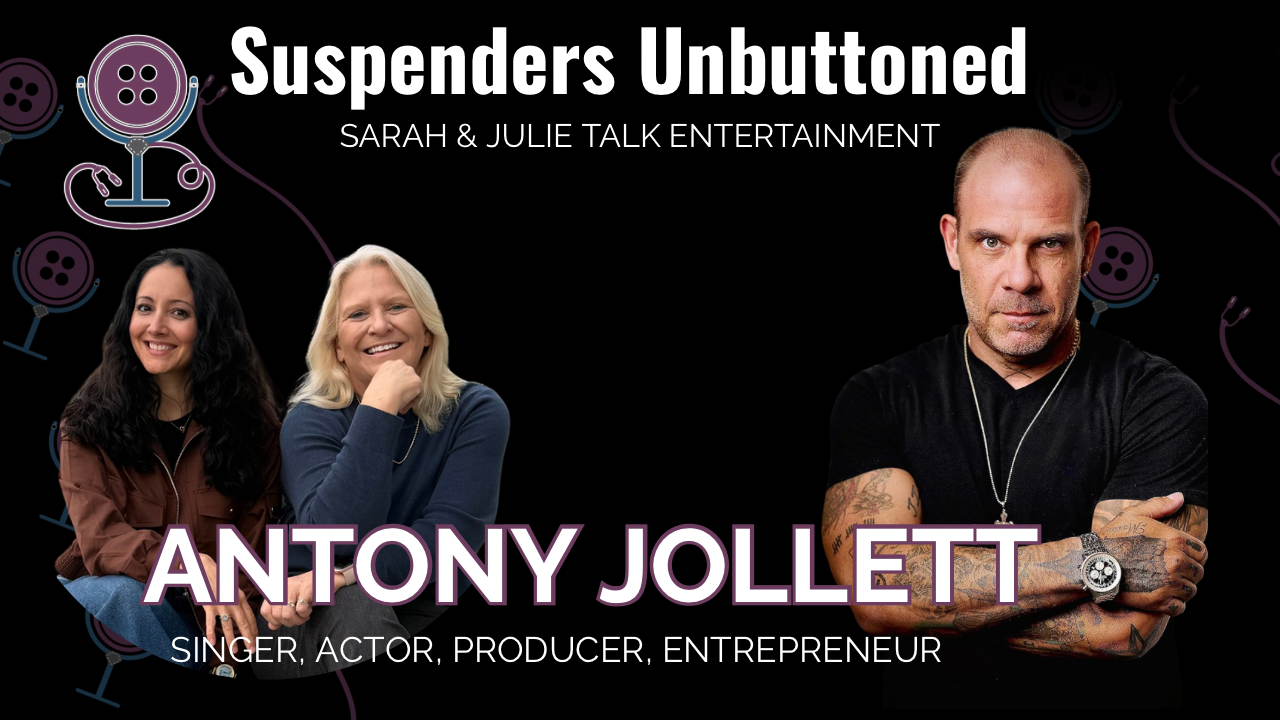
Anthony Jollett on Choosing Love, Creating with Purpose and Telling His Story
The CEO, actor, producer and recording artist opens up about surviving Synanon, building a people-first company, becoming an artist and transforming a painful history into a message of possibility.
Anthony Jollett’s career does not fit neatly into a single introduction. He is a CEO, entrepreneur, actor, producer and recording artist. Ask him what he does, however, and he offers a simpler answer borrowed from his daughter: he solves problems.
That description captures more than his professional life. In a deeply personal conversation with Suspenders Unbuttoned Media, Jollett reflected on building a nationwide business, finding creative outlets through acting and music, and making a conscious decision to create love and purpose from a childhood marked by trauma.
“Anything is worthwhile as long as you have purpose,” he told Sarah and Julie.
Content note: This conversation includes discussion of childhood trauma, violence, addiction, coercive control and forced medical procedures.
Building a company around people
Jollett’s primary day-to-day work remains the printing company he started approximately two decades ago. What began with one person grew into a business with locations on both coasts and work supporting out-of-home and experiential campaigns across the country.
The achievement he values most, though, is not the company’s size. It is the culture its people have created.
Jollett described a workplace where employees support families, receive benefits and build lives, but he returned repeatedly to something less measurable: the way people care for one another. He recalled realizing that grown men in the company were comfortable hugging one another goodbye at the end of the day.
“That’s the first time I really felt true success,” he said.
His guiding principle is direct: the job is never more important than the person. Although he founded the company, he no longer thinks of it as his alone. It became a community, and he credits that community with carrying the culture forward.
Setting his own standard
For much of his life, Jollett said, he made choices based on what might please other people or influence how they viewed him. A small moment while getting dressed prompted a larger realization: instead of wondering how someone else would judge his appearance, he asked how he felt about it.
That question changed the standard he used across his life.
“I have my own bar,” he explained. “I have my own standards for myself that aren’t based on what other people’s opinions may be.”
Removing the constant search for outside validation did not lower that bar. He found that his own values demanded more of him. Across business, film and everyday interactions, the question became the same: What is the right thing to do?
Finding an artistic outlet
As his company grew, Jollett realized that he needed a creative outlet. He did not simply decide to call himself an actor. He joined a theater group, trained for a year and then spent another two years studying work for television and commercials.
“Anything is possible,” he said, “as long as you’re willing to put in the work to do the thing that you want to do.”
Acting offered him the chance to inhabit someone else’s experience for a while. Producing demanded a different kind of care: bringing together actors, crew members, locations, lighting, sound and countless moving parts while making sure collaborators did not feel used or undervalued.
Jollett discussed taking on both acting and producing responsibilities for Meantime, a project led by filmmaker Elyes Baccar. He emphasized Baccar’s leadership and resisted taking disproportionate credit for the production. The story, he explained, follows intertwined experiences of women, including Iranian women who arrive in the United States expecting freedom from gender-based inequity and discover that discrimination crosses cultures.
When acting in a scene, Jollett said he must put the producer’s responsibilities aside. As a method actor, moving fully into a character requires a focus that cannot easily be switched on and off.
Music makes the story personal
Acting allows Jollett to step into another person’s skin. His music does the opposite: it reveals his own.
He began writing and recording in earnest only months before this conversation, after years of experimenting with production tools and song structure. Once he committed, the material began “pouring out” of him. Some songs are intended for the public. Others, including pieces written about members of his family, may remain personal gifts.
Commercial success is not his first test of whether a song works. He is more interested in whether it is honest, meaningful or capable of helping someone.
That vulnerability has a cost. Jollett admitted that reading careless or malicious online comments can be difficult when the work comes from events he actually lived through. He has learned to step away instead of trying to convince strangers on the internet.
The possibility that a song could reach someone who needs it, even if he never knows that it happened, makes the exposure worthwhile.
The story behind “He Chose Love”
Released on August 15, 2026, “He Chose Love” grows directly from Jollett’s childhood in Synanon.
Synanon began in California as a drug rehabilitation community and later became an authoritarian and violent organization. Jollett described being separated from his parents, living without a conventional understanding of a mother or father, experiencing sleep deprivation and violence, and being trained to respond to the world with aggression.
He also distinguished between the group’s hopeful origins and what it became. In his telling, many people entered a community they believed would create something better, only to find themselves inside a system where a small number of people held dangerous power.
Eventually, Jollett said, he had to decide what kind of person he would become.
“I was being taught to hate and to hurt,” he explained. “Instead, I made a decision that I’m going to do the exact opposite.”
“He Chose Love” is the musical expression of that decision. It does not deny what happened or minimize its effects. It asserts that the harm does not get the final word.
Jollett’s brother, Mikel Jollett, has also written about their childhood in the bestselling memoir Hollywood Park. Synanon has been examined in projects including HBO’s The Synanon Fix, Paramount+’s Born in Synanon and the podcast The Sunshine Place. Anthony Jollett believes a crucial perspective remains underrepresented: the experience as seen through the eyes of a child who lived it.
Telling his story through film
That child’s-eye perspective is central to a film project Jollett is developing with two experienced partners. Progress has been deliberately slow. Writing sometimes requires him to revisit memories so painful that the team must pause.
He compared the process to method acting: to write honestly, he has to carry the emotional material close enough to draw from it, even when doing so is difficult.
“It’s a hardship and a superpower at the same time,” he said.
Jollett does not claim to know whether the eventual film will be commercially successful. His goal is to make it honest, compelling and meaningful. For him, that is the measure that matters.
Teaching his children to act while afraid
The conversation became especially vivid when Jollett spoke about fatherhood. He teaches his children that courage does not require fear to disappear first.
He completed endurance events, including a half-Ironman-distance triathlon, while afraid because he wanted his actions to support the lesson he was teaching. When one of his daughters hesitated to pursue student council, his message was not that she should stop feeling nervous. It was that she could move forward while nervous.
He shared a smaller but equally meaningful example involving a daughter who wanted her ears pierced but feared the pain. Rather than pressure her, he helped her separate two questions: Did she truly not want it, or did she want it and feel afraid? Once she decided the desire was real, he held her hand while she took the first step.
“You can do things and be afraid at the same time,” he said.
That lesson extends beyond parenting. Jollett sees fear as something that often appears enormous from the front but “paper thin” once a person steps through it.
“Do the thing”
Jollett is continuing to release music under Anthony Jollett, including “He Chose Love” and “Music to the Sky,” while developing his film project and leading his business. He does not see creativity as a lane that must be selected once and followed forever.
Actor. Producer. Musician. Entrepreneur. Perhaps, as he joked, a clown next week. The title matters less than the willingness to begin.
His final message was also the clearest summary of the entire conversation:
“Do the thing, whatever that might be for you.”
For Jollett, choosing love was not a single symbolic act. It became a standard applied to his workplace, his art, his children and the story he is finally ready to tell.
Watch the complete conversation with Anthony Jollett on Suspenders Unbuttoned Media, and listen to his music on major streaming platforms.